 The Judge
RAVES!
The Judge
RAVES!
Date: 23/08/25
On The Border
I had to do it.
There were two reasons why I felt the need to go to Oswestry again after the fiasco of my first attempt: firstly, I was aware that there was a lot worth seeing there and I didn't want to short-change the place; and secondly, sheer bloody-mindedness in not wanting some ha'penny Iron Age tumulus to defeat me.
The over-warm weather had delayed this trip, so it was this Wednesday morning past which saw me catching the T12 once again and heading southwards. As before, the journey was a swift and pleasant one - one, moreover, without the turn-around detour in St Martins - although, unlike last time, the bus was very near full ( with the average age of the passengers being largely greater than my own) once we had picked up in Gobowen village, and I arrived in Ozzy's Cross at about 1020.
On the way down through Chirk, it started raining (which hadn't been forecast), and it drizzled continuously for most of what remained of the morning.
Turning left out of the bus station, I walked along Beatrice Street, reaching the turning right on to Castle Street a little sooner than I had expected (maps and Google Street View tending to give whatever the opposite of a foreshortening effect might be called). Up my first hill of the day and then left onto Powis Place (another slope) and then to my first target of the day, namely the town's Market Hall. This was a modern building, a bit like the Art Space at the Eisteddfod a couple of weeks ago.
Going in, I could see that the sides and centre of the space were covered in stalls, and that there was an upstairs gallery arrangement as well. I walked past a suitably aromatic fishmonger's (that is, the stall smelled; the fishmongers themselves I can't vouch for because I didn't want to get that close) and worked my way around. I found that there was a stall selling used vinyl, and for some ten minutes or so I indulged myself in a little light browsing, but in a far more detached way than I used to; I haven't bought any small pieces of black plastic with a hole in the middle for some fifteen years, having now only one of those USB turntables you plug into a PC to play them on (and I digitised all of mine many years ago anyway). Continuing around, there were stalls selling clothing alterations, jewellery, cosmetics and various other trinkets and wotnots. Walking up the ramp to the upper level (there is a lift if you need it), there were tiny emporia dealing in haberdashery, books, vintage guitars and action figures amongst other things.
In short, it was a market hall like all good ones used to be, and I got nostalgic for the days when Wrexham had not one, but three such halls, before changing shopping habits and civic neglect led to their demise.
Emerging from the hall pleased that some towns at least had had the determination to maintain and encourage such things, I went looking for my second intended destination, namely the ruins of the town's castle. I didn't need to go far, as it is essentially back of and above the market. This may not in strict terms be "one of the ruins that Cromwell knocked about a bit" (to quote an old song) - in fact we gave it a bit of a bashing more than once - but the internecine strife of England's Civil War finally reduced it to rubble.
I walked around the far side, from whence the top may be approached by a series of steps. Oh, those steps! These seemed to be unfeasably high and required a fair bit of high leg-lifting to negotiate. On top of which, the paths up and around the edifice were somewhat coarse on the feet (although nowhere near as bad as the ones up the fort which I had encountered three weeks previously). Once at the top, I saw that it gave some very good views across the town, and I took a few snaps of the surrounding streets.
Then I made my way down the steps. This was in many ways worse than ascending them because of their height. On one step, I landed heavily on a particularly prominent stone and hit on an especially tender part of the sole of my right foot. Cursing as loudly as I wished (as there was no-one within hearing distance), I hobbled off in search of the Town Museum, although I wasn't clear where in fact this was.
On my way across the top of the road, I became aware of a series of loud, high-pitched noises. Looking around - half expecting to see something like a car with one wheel falling off - I saw a woman with three children; one in a pushchair, a boy of about four years of age, and a girl of about seven. It was from this girl that the racket was emanating. To say that this child was having a meltdown would leave no appropriate word to describe the self-destruction of a nuclear power station. She reminded me of The Demon Childwhom I would encounter on the bus on my way to work of a morning. Her mother (to make a reasonable assumption) was trying alternately to reason with and castigate the bratette, both strategies doomed to fail.
Heading down Albion Hill, I found myself on a small square where people were setting up market stalls in the drizzle, for this turned out to be the outside of the rear of the market hall. Turning to my left, I found myself at the front of the imposing greystone building I had, in fact, just taken a photo of the back of from the castle. This was the town museum, housed in a building which was constructed in the Renaissance style towards the end of the nineteenth century. I climbed the short flight of steps to the front door and entered.
Oh, hell's bells! More stairs! At least they were shallower and carpeted, but there were several flights of them to negotiate before reaching the topmost floor. On the way up were a sequence of small presentations giving a timeline of the town's extensive history, with a noticeable focus on World War I, but then when one considers that the nearby Park Hall camp was set up at that time, remaining in military use until my own lifetime, this perhaps shouldn't be a surprise.
(As an aside, the Depratment's Oswestry office - closed, like so many others, in the early years of this century - operated out of a building in the town which had originally been a parsonage, then added to to create the NAAFI for Park Hall, with a later addition in the 1980s or thereabouts. I only visited it once, and came to the conclusion that because of its sequential development it could have been used by Ariadne as a dry-run)
There were also displays of photographs of classes from the various schools of the town, mostly, it seemed, from the girls' school. I stood before one of a class of young ladies dated 1954, and - as I tend to do when viewing such things - pondered on what might have become of those pictured in it; what sort of lives did they go on to lead, and did they find happiness and fulfilment?
Reaching the topmost floor, there were further displays of photographs, but two sets of exhibits took the eye. One was of surgical instruments used at the famous orthopaedic hospital at Gobowen (there were also displays of woodworking tools in a worryingly adjacent cabinet, which could leave one to wonder whether they too might have been used therapeutically at Gobowen); and the other was of the museum's prime exhibit, namely, the world's largest collection (authenticated by Guinness) of ear-trumpets, the so-called Packington Collection, rounded up by a local obsessive and donated for permanent display to the museum (and you thought philatelists were mad).
Being conscious of the time (and if you can't be conscious of time in a museum, where can you be?), I made my way slowly down all the stairs, out through the door and back into the square. It was drawing near to lunchtime, and I knew exactly where I wanted to spend it. So I made my way down to the bottom of Albion Hill, passing on my way one busker who was busy mangling Nirvana's Heart-Shaped Box and another who was playing trumpet to a karaoke tape of My Way determinedly (if consistently) a quarter tone flat.
I knew that I needed to head generally westwards to my next destination, but was unsure of which way west actually was. Shortly afterwards, thanks to some helpful signage, I found myself at the gate of Cae Glas Park.
(A note here that the fact that the Oswestry area was once largely ours - a sort of Gwalia Irredenta if you will - is reflected by many of the place names hereabouts; some opinion polls conducted in the area in recent times have suggested that more people here identify with our side of the current border than with the one they're actually living on)
This large area of land was sold to the town council in 1908 by its owner with the express condition that the property be used as a park and pleasure ground, and in this guise it was opened in June of 1910 and expanded once or twice since then.
The Church Street entrance (other entrances are available) consists of almost stereotypical ornate gates and pillars, upon which are carved the names of the dead of the 'Great' War. Passing through these brings you immediately to some very neatly laid out and colourful flower beds. These at the time of my arrival were being tended by the town mechanicals (whether they were rude mechanicals or not could not be ascertained as they weren't saying anything).
Beyond that stood the main reason for my wishing to lunch here.
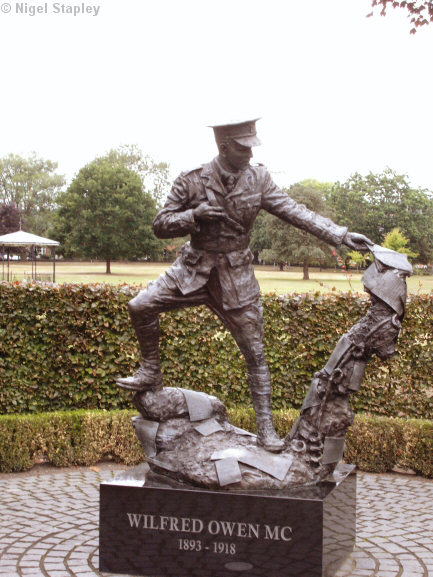
I mentioned in my Shrewsbury travelogue the appallingly 'conceptual' memorial to the poet Wilfred Owen behind the abbey there. I knew from my research that Oswestry had its own tribute to its home-town hero, and that it seemed from the photographs to be far more worthy of the man. And so it proved to be as I stood pensively and respectfully before local artist Tim Turner's bronze statue, which was unveiled in 2018 in the run-up to the centenary of Owen's death:
Passing through to the main open area of the park, I looked around for somewhere to sit. All of the benches and tables were off over to my right and only one of them was completely unoccupied. There I sat and gobbled down my bacon sandwiches, my Seabrook's cheese and onion crisps and my Cadbury's Twirl and looked around me.
The main grassy area bore the hallmarks of the long, dry summer we've had, with large expanses of yellow and brown amidst the green. There was a small bandstand off in the middle distance and a children's play area some thirty yards to the right of me, which was mercifully free of the screaming brat sub-species.
Although it had long since stopped raining, the light wind blowing across the park had a real edge on it and made me feel pretty cold.
Repast duly finished, I set off back to the main gate to seek out my final target for the day. Walking through the streets of the town, I noted that - like Shrewsbury, but on a slightly smaller scale - Oswestry has kept its character. Nearly all the buildings were of mid-20th century vintage or older, and they were occupied overwhelmingly by small local traders. This is how it should be for all such towns, rather than the over-ambitious modernism which has blighted so many places (I'm scowling at you again, Wrexham).
Back along Church Street and Cross Street and then onto Oswald Road I went, in pursuit of the Cambrian Railway Museum.
Oswestry had a long history with railways, and at one time had two railway stations, because - in that piecemeal way in which the railway system in this country was set up (and is run today, truth be told) - there were two companies operating to, from and through the town. The Great Western Railway (GWR) came first in 1849 with a spur off their Chester to Shrewsbury line from Gobowen. In 1860, it was joined by the Oswestry and Newtown Railway which - after a number of mergers - became the Cambrian Railway (CR) four years later. This ultimately ran from Whitchurch in north Shropshire across via Oswestry to Welshpool, Newtown and Aberystwyth.
But ways change, and even permanent ways aren't (permanent, that is). The GWR service for passengers was closed in 1924, after the GWR had merged with the CR. As the Cambrian had the better station building, all trains (including the spur to Gobowen) now ran to that one, and the GWR station closed to passengers, continuing as a goods depot until 1971, with the building being demolished a few years later (Oswald Road (q.v.) was laid over the site). Trains on the Cambrian line (by then the London Midland region of British Rail) ran until 1966 before the Beeching Axe fell (although a through line for freight continued to the quarries at Blodwel until 1988).
Various attempts at setting up a heritage line were made from the early 1970s onwards, but various difficulties have meant that there is still only a short run of track to Weston Wharf just to the south of the town.
(See here and here for more on the history.)
The former Cambrian Railway station - having fallen into dereliction after closure - was renovated some twenty years ago, and now houses the Museum. It's quite a small space (but, note, no steps!), and is crammed with memorabilia and documentation. What it also has is that beguiling aroma of lubricating oil and old metal, which permeated the air as I wandered around looking at old signage and equipment from the times before the dreaded private car took precedence over everything. On the way out, I had a chat with the guide, who told me that they'd had a mishap the previous Saturday with the steam engine they had borrowed from the Llangollen Railway, and which would now have to undergo a cumbersome repair.
Leaving the museum, I checked the time and found that it was a little after 1330. As I had seen everywhere I had intended to see, and given that it was still distinctly chilly, I decided that my day in Oswestry was over and headed for the nearby bus station. The T12 duly arrived on time and I went home.
Overall impressions? It's a nice place, and even after this visit there are still parts of it I would wish to go back to or to view for the first time. Although I'm sure it has its problems like everywhere else, it seems in both style and substance to be an eminently liveable and civilised place.
Postscript (01/09/25): Scarcely ten days after I made this trip, the T12 service between Machynlleth and Wrexham was withdrawn due to funding issues. Now, there will be a service from Machynlleth to Newtown, with a connection from there via Oswestry through to St Martins. The service will no longer run any further north than that, which means that the only service from here to Oswestry will be the all-around-the-houses Arriva service which takes twenty minutes longer. Progress?


