 The Judge
RAVES!
The Judge
RAVES!
Date: 09/09/25
Into The Valley
(or, Incoherent Ramblings #4)
My great hopes of visiting seven nearby towns this summer crumbled in the face of two factors: firstly, the weather being either too warm or too wet, as summer slipped dribbling incontinently into its decline; and secondly, my own personal sloth.
(Did you know that I had a personal sloth? Cute little thing it is. Can count up to twelve. Anyway...)
I realised that there was too little of what was left of summer to get around to Mold and Ruthin, and Chester might have to wait as well (although much of Chester is indoors, and I might be able to combine it with meeting up with an old friend).
That left Llangollen. I had shied away from going there in July because of the International Eisteddfod and all the crowds, but I now felt that any such peril had abated.
So it was that last Friday morning I set off from JudgeCo™ World Headquarters just before 0930 in order to catch the Service 5 from Wrexham at 1000 (the service runs half-hourly). At the bus station, I went to Stand 5, which was where I thought it ran from. Only to find that it didn't. I'd got my fives mixed up, and had hurriedly to consult the destination board, which told me that Stand 1 was the one.
After about five minutes, the double-decker duly turned up and I boarded. I had decided that - given that rides on deckers were a rare occurance for me (the one to the Eisteddfod had been my first for many years) - I would not only go upstairs, but would (if no-one had beaten me to it) esconce myself at the very front. I was the first one up there, and so I plonked myself down just behind the windscreen. A few more minutes, and off we went, down Bradley Road and Victoria Road before turning right onto Ruabon Road and out of town.
One thing I noticed about sitting where I was was a misleading perception of alignment. More than once I thought that the bus was going to clip a lamp-post or building as it negotiated junctions, because it seemed to be turning rather too late to avoid contact. Not true, of course, but it was a rather unsettling feeling until I got used to it.
Through Rhostyllen we went, over the A483 and past Packsaddle, where stands the water company's local headquarters, and Pentre Bychan (a place notable only for being the location of the local crematorium) and on towards Johnstown.
At this point, I looked up at the coachwork above the front windows. Most of it was taken up by the sign which says "Bus Stopping", which lights up when someone presses the bell. Above it was the number "1012". Hmm, I thought, we're making good progress if it's only taken us twelve minutes to get here.
Then it was on into Ruabon (but without the detour to the railway station which features on the T3 service), down over the Afon Eitha, and then to the A539 westward, skirting the large Plas Madoc estate (a good idea given its reputation), up the slope to Acrefair and then down into Trevor.
At this point, I looked at the clock again. It still read "1012". Oh, I thought, the clock's not working.
It was another mile or so before I finally twigged that it wasn't a clock, but the vehicle's fleet number.
We then came to the nicest part of the route, and I got an enhanced view across the Vale to the heavily-wooded slopes of Cwm Alis and Croes Yr Esgob across the river to the south, with a reassuring amount of medium and dark green still in evidence. The Llangollen Canal ran along the left-hand side of the the road, with two or three boats chugging meaninglessly along. After a mile or so, we crossed over the canal and past both a sewage farm and a caravan park (there's a metaphor there somewhere, I suspect).
Finally, we were there. The bus turned left to go over the bridge and up Castle Street. Market Street and East Street followed as we made circuitously for the bus station.
Getting off (whilst trying not to fall down the stairs), I turned left at the end of Parade Street and headed back down towards the bridge. Looking over the parapet, I could tell that the river was in full spate. I didn't need to actually see it, mark you; the racket the water was kicking up as it passed over the weir couldn't be avoided, and after a few moments of hearing it, I wondered how anyone living close by could live with the persistent volume.
I noticed that - unlike when I had passed through on my way to Y Bala a few weeks ago, when the Flags Of All The Nations had been in evidence for the Eisteddfod - there were few banners in evidence. I walked along, stopping to take the sort of pictures that everyone takes when they're there, and eventually reached the far end and turned left onto Abbey Road (and no, I didn't see four weird-looking guys - one with no shoes on - walking across the zebra crossing; there wasn't a zebra crossing for one thing). There stood the railway station, another example - like the line along Bala Lake - of what were once public services being resurrected as 'heritage'. Nothing much seemed to be going on there (perhaps they hadn't manage to fix the locomotive they had lent to the Cambrian), and I took a few snaps of the station, as did a number of other people. As I turned back towards the bridge's northern end, there was a group of four people, one trying to take a photo of two of the others whilst telling the fourth member of the party (who was standing with his back to them taking snaps of the railway) to get out of the shot.
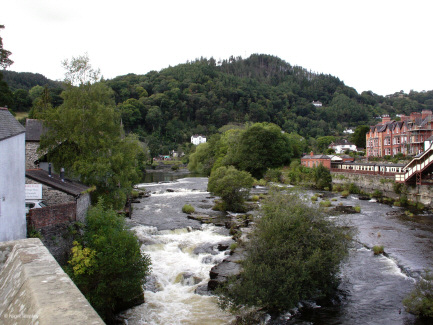
Crossing the northern end of the bridge, I found myself on Mill Street and proceeded along it in an easterly direction until I found a path which led down towards the river. The walkway was made of what seemed to be metal plates with a rubber-like coating on it, which was certainly an improvement on some of the paths I had experienced on my previous outings. The path zig-zagged down to a small platform right at the water's edge, where I stood taking in the view of the Royal Hotel opposite. Then under the bridge came a middle-aged man in a kayak followed by three younger people in an inflatable dinghy. They were manoeuvering towards where I was standing, which is when I realised that I was standing on a jetty. I moved away back up the path again and watched them manipulating their vessels onto the platform. As I headed back up towards the street, I had to move out of the way to allow the dinghy-wranglers to pass. I then saw a strange-looking contraption at the town end of that section of path. I puzzled at it for a moment; it was a metal (iron?) frame with what looked like gear wheels atop it, and within the frame were lateral sections of wood. I could only assume that it was a sluice gate or some such, perhaps to moderate the flow of water should the river surmount its banks at this point.
Turning to my right, I saw that there was another channel between me and the wall up at street level, and I realised that that had been the trackbed for the railway line which had once run westwards from Ruabon Junction through to Bala Junction and beyond. The current Llangollen Railway runs from the western side of the bridge out towards Corwen, which is the full extent of the line nowadays.
Reaching the top of the path, I turned left back onto Mill Street and towards the bridge once more, as it was time to explore the town further. Behind the Royal, I turned left along Bridge Street. Like the rest of the town centre, the buildings were of some age - none of this modern rubbish - mostly white-walled, and seemed to be largely residential, but with the odd small business here and there. Local small businesses, mark you, much like Y Bala and Oswestry (and Shrewsbury to a large degree as well).
I had passed the large beer garden of the hostelry to the left between me and the river when I saw St Collen's church appear to my right. Because even to an avowed atheist churches and cemeteries are eminently readable, I approached the gateway. On arrival, however, I saw that there was a small group of people gathered at the church door whose attire (and age) suggested strongly that a funeral was taking place. I edged away, not wanting to intrude, and retraced my steps and turned left up Chapel Street.
This brought me out onto Berwyn Street aka the A5, whioh as one would expect was pretty busy with traffic. It was getting near to lunchtime by this point, and I realised that there was little to see along there, I turned around and headed back, turned left by Seion chapel (which was still advertising the millenium as being Jesus' birthday) and walked back down Castle Street because I had spotted an ideal place to eat my standard bacon butties and Seabrook's. Passing the Oggie Shop (and resisting the temptation to supplement my lunch), I reached the end of Bridge Street again and sat down on a bench before the town war memorial.
I was facing this monument, which was in the form of a Celtic cross (and noticing that virtually the whole of the inscription was in English, which wouldn't have reflected the linguistic make-up of Llangollen and Llantisilio at the time of the Great War). There was a quote on the plinth: "Live thou for Britain / We for Britain died". I couldn't help wondering whether a more apposite - and accurate - statement would have been "Live thou under the same footling wankers who sent us to our deaths for their empire, and who will do the same to you and your children scarcely twenty years hence". I supposed that there hadn't quite been enough room on the plinth for such reality.
As I sat there, I heard the bell of St Collen tolling, so my assumption of rites of despatch seemed to have been correct.
Suitably nourished, I set off back towards the bridge, but this time hung a left (as the Yanks say) and headed down the narrow Dee Lane. This leads to the Victoria Promenade, opened in 1897 to commemmorate the old bint's Diamond Jubilee. It runs parallel to the river, but the bushes and trees there screen much of it off from the promenading public, this including the substantial number of people who were walking their pooches of various sizes and breeds.
After a hundred yards or so (and a nice little rest on one of the benches where the vista was not obscured by foliage), I headed back to the Parade Street end of Dee Lane, as I had one more place to visit before taking the bus home from the adjacent bus station, namely the town museum...
...only to find on approaching it that I had incurred the Curse of Shrewsbury Market, viz. and to whit, that I had picked the one day in the week where the museum was closed. Oh well, I suppose it'll be something to check out the next time I go...
As I said, the bus station is on Parade Street, so I stood waiting for a few minutes before another of Arriva's beasts of burden swung around the corner from East Street. I clambered aboard, mounted the stairs and found that I once again had the front nearside seat to myself (except for the detritus from someone's visit to McDonalds). As I was sitting to all intents and purposes on the opposite side to before, I got clear views of the beautifully rugged Trevor Rocks and Eglwyseg Mountain beyond. The journey home was uneventful and - after a quick bit of shopping in Wrexham - I was home before three o'clock.
Final thoughts: it's a very nice place, containing and surrounded by gorgeous geography, and - being a small town - you can get around to a lot of things of interest in a single day. So long as you pick the right day, of course...


